A lot is happening and it's easy not to see it. We're all in our own world, watching AI brainrot videos and whatever other content is on social media, and meanwhile the degree you're studying or the job you're in is being automated.
And when it's your turn to become an adult, or when this change reaches your job, you may find that you can no longer compete in the same way. Not because there is someone better and more prepared than you, but because it's not necessarily going to be someone anymore. It's going to be something. A machine capable of doing, at industrial scale, many of the things you're preparing for, potentially a hundred times faster.
And don't come at me with the idea that we guide the AI and control it because we know what we want and it doesn't. Of course human intention matters. But that doesn't mean we will always need a person executing every task, or that all the job opportunities you thought were open to you will keep existing.
And that is what you're about to read…
It's not so that you're afraid. It's so that you know what is happening.
First, who am I and why am I telling you this?
My name is Bernardo, I study Actuarial Science at Universidad Anáhuac México Norte, I'm in my fifth semester and, curiously, not because I want to be an actuary. In fact, I don't want to be one. I got into this degree to have mathematical foundations for something I liked much more… programming and artificial intelligence.
Since I was 10 I've been into all of this, programming, building electronic circuits, researching machine learning and deep learning algorithms (AI jargon), building things and even uploading programming videos. I'd get home and start researching, reading, building and watching tutorials. I didn't get bored. It was what I liked, and it still is.
You could say I know nothing about AI and programming because I'm still in university, I'm in my fifth semester and I'm 21 years old.
Well, I've been in this industry for 11 years, and I've also spent five years working at an Australian company as a systems architect. I'm involved in everything new that comes out, in how we adapt it and in how we bring it to our clients. Right now we focus on offering AI services for businesses (B2B) and automating their processes. I'm not here to sell you anything.
But, apart from that, I like to research. Not long ago I finished programming and writing an article about how to build an LLM from scratch, using mathematics and implementing it in C.
So… of course I know how it works. Or, at least, I have enough experience to understand what is happening.
Anyway, that's not the point.
The day programming stopped being art
I remember that, before all of this came out, I loved writing on the computer. Writing code was an art to me. Thinking it through, designing it from scratch, finding a solution, seeing how to optimize it, discovering a more elegant way to solve a problem... simply art.
I could spend hours thinking about how to build something. Every line had a reason to exist. It was me against the problem, and finding the solution was part of the satisfaction.
Now I barely write code for work anymore.
My main interaction is with a coding agent, Claude Code, although there are several. I have an intention, I explain what I want to build, and the agent can take care of investigating the code, designing a solution, implementing it, running tests and fixing errors. I still make decisions, review results and define the architecture, but the way I do my job changed radically. I have my own harness, which is what AI experts use today to direct agentic swarms.
And the most impressive part is that, on certain tasks, it can produce in an hour something that would have taken me days. Not necessarily because it's smarter than me in every sense, but because it can work at a speed, a scale and with an execution capacity that completely change the economics of work.
The programming industry is already adapting to this. More and more, the difference between working with AI agents and working without them is so big that it's hard to justify doing by hand many of the tasks that used to make up our day to day.
That change arrived in my life and I lost part of the joy of doing what I liked most. It was my way of making art. But, like a good citizen looking for a better life, I adapted. I'm still in this industry and I'm already getting used to this new reality.
At the company I'm at we don't even have schedules in the traditional sense. It's not part-time or full-time, or any of those labels we use nowadays to describe work.
My schedule is, in a way, the token usage.
If the tokens on my Claude Enterprise subscription run out, I have to stop or change the way I work. I could keep programming by hand, sure, but if Claude Code does in an hour something that would take me three days, what's the point of insisting on doing it the same way when my goal is to finish the work?
And the next day, when my usage capacity is available again, I can continue.
This is what a small part of the transformation looks like from the inside, it's not only the tool you work with that changes. The rhythm of work changes, the way you distribute your time and even the way you understand your own productivity.
And that's only programming.
We're wasting time, but not for the reasons you think
It amazes me to keep hearing in universities and schools (not only in Actuarial Science, not only at Anáhuac) that they keep assigning homework that may soon make very little sense in its current form. It amazes me that artificial intelligence is still being treated as just another tool, something similar to when Excel arrived or when everyone started using computers.
But this is bigger. And we're wasting time if we don't understand the difference.
Normally, in the Actuarial Science degree they tell you something like this: "You're never going to use an integral at your job, but we teach it to you because you need to develop the analytical thinking to solve the problems you'll face in the industry."
And I TOTALLY agree.
Not everything you study has to be used literally at your job. Learning mathematics is also about developing a way of thinking, building intuition, understanding structures and learning to solve problems you don't know yet.
But what happens if the industry you're developing those skills for changes radically?
What happens if the tasks you're preparing for can be automated, if a single person with AI can do what ten used to do, or if a company no longer needs to hire as many professionals to produce the same thing?
Do we keep teaching exactly the same thing, in the same way, with the same evaluations and under the same assumptions about the job market?
And what if this revolution is so deep that it makes our traditional analytical thinking obsolete, completely transforming people's minds and the logic of the industry?
Because it's one thing to learn the foundations of a discipline and a very different thing to prepare yourself to manually execute tasks that, by the time you graduate, may no longer have the same economic value.
The problem isn't studying integrals. The problem would be not asking ourselves what we're training people for in a world that is changing so fast and IS GOING TO CHANGE.
And the interesting part is… the foundations may be even more important than before, but the way of using them may have to change completely.
What happened with the internet and computers? (1970-2010)
The revolution of computers and the internet transformed the economy, communication, commerce and practically every industry. What used to require physical infrastructure, intermediaries, travel or manual processes started being done through digital systems.
Who would have imagined that the average human being, in 2026, would pay for several subscriptions a month to watch movies and series?
Years ago, having Netflix was already something special. Then came Amazon Prime Video, Disney+, HBO and many other platforms. Those of us who are movie fans end up paying for several, because each one has something we want to watch. We pay for internet, mobile service, cloud storage, music services, software and many other things that a few decades ago weren't even part of our everyday expenses. And we can't live without it.
And now, in 2026, it's also more and more common to pay for artificial intelligence subscriptions. A few years ago, telling someone you would pay hundreds of pesos a month to talk to a machine that helps you write, program, research or solve problems would have sounded pretty strange. And can you live without it right now? Unconsciously, we build dependencies when there is a big technological change.
The thing is that the big digital companies built business models around the possibilities that revolution opened up. The economy changed because the goods and services we could produce, distribute and consume changed, as well as the infrastructure we depended on.
The internet didn't only let us do faster what we were already doing. It also created needs, markets and ways of living that didn't exist before.
Today it's hard to imagine the world without the internet. A good part of our economy, our communication and our everyday life depends on it.
And I think we're starting to see something similar with artificial intelligence, although we still don't know how far it's going to go.
Without the internet, many businesses stop. At my job, if I run out of tokens, my capacity to produce changes radically.
It may seem silly, but think about this… a part of my job depends on accessing a certain amount of computational capacity so that a machine executes tasks that I used to do directly.
And I'm not the only one experiencing a change like this. There are more and more professionals who bring AI agents into their work, and some companies are reorganizing their processes around them.
Programmers, mathematicians and other professionals who work directly with these technologies have a particular advantage… they tend to experience these changes before many other industries, because they're close to the tools that make them possible.
And what we're seeing should make us reflect.
When the machine starts doing science
A few weeks ago, OpenAI started publishing mathematical results generated by one of its AI models. And we're not talking about solving calculus exercises or winning a math olympiad. We're talking about research that can take years of work, open problems and proofs that could contribute new results to different areas of mathematics.
One of the examples that caught my attention the most was Integer multiplication below n log n, a piece of research that presents an algorithm capable of multiplying -bit integers in a theoretical time below , questioning a limit that had been considered optimal for decades in that model of computation.
And this is only one of the published results.
Obviously, it doesn't mean that everything that was published is right, or that all the proofs are verified, or that every result is a revolutionary discovery. That's precisely why there is so much discussion. AI is already starting to take part in mathematical research in a way that seemed very far away a few years ago.
And, as expected, there is a lot of controversy among mathematicians. You only have to go on X to see the discussion about the validity of the results, the need to read and verify the papers, and whether we can really consider this a new way of doing mathematics.
I agree that you have to read them, understand them and check them. You can't simply accept hundreds of proofs because an AI generated them. But it also reminds me a lot of what happened with programming. At first, the discussion was that you had to read every line of code, understand it and write it yourself. And although that is still important in certain contexts, we're reaching a point where producing code is no longer necessarily the most important part of the job.
I think something similar can happen with research. Maybe there will come a time when we don't have to read every page of every paper generated by an AI, but instead develop new ways of verifying results, evaluating their importance and deciding what deserves our attention. Research wouldn't disappear, but the way of doing it could change completely. And I think we still aren't grasping the scale of what that means.
And that is something else.
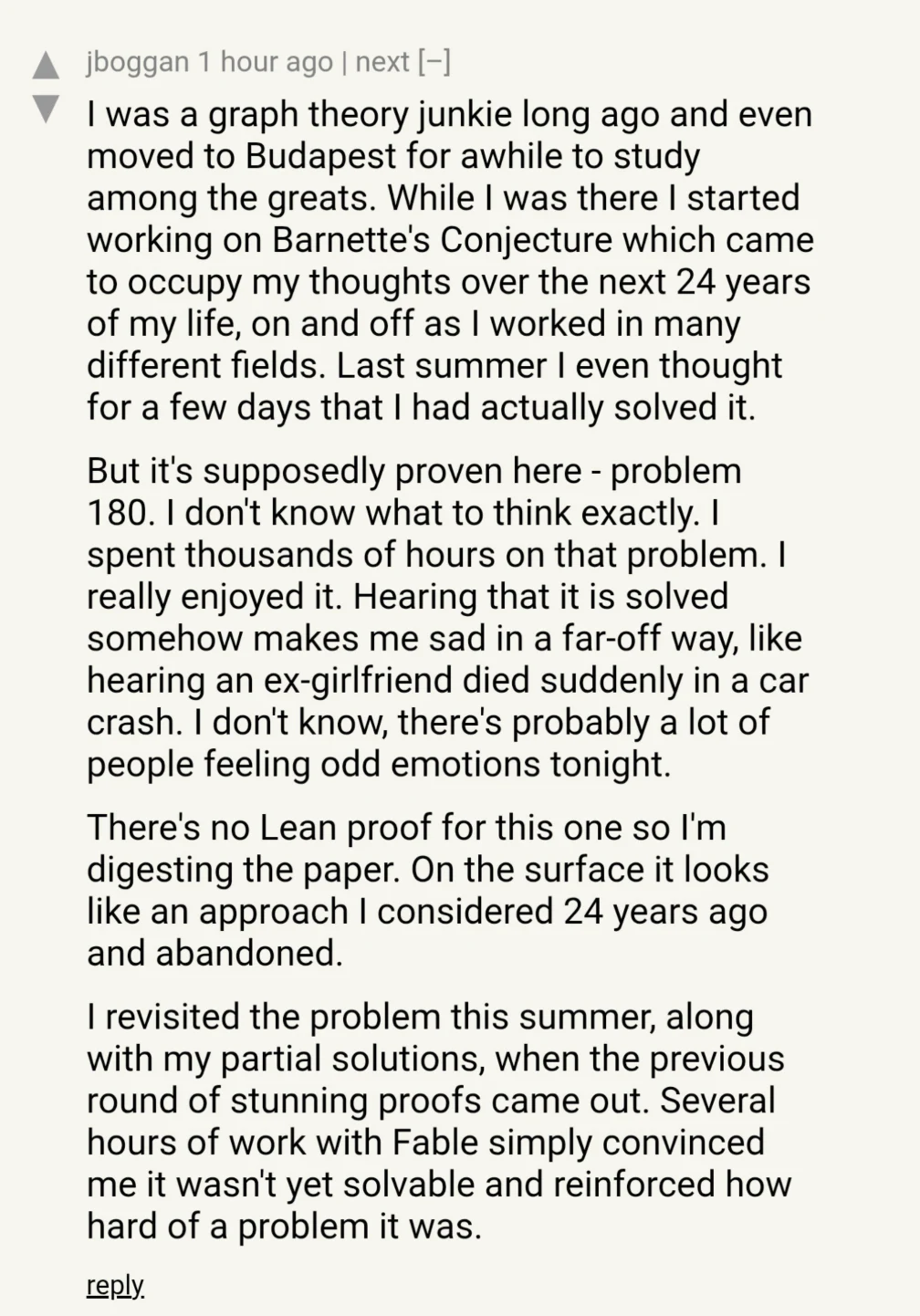
What for years has been the art of solving mathematical problems, the result of decades of a researcher's training and experience, is starting to meet systems capable of accelerating parts of that process in an extraordinary way.
The direction of the change is what interests me.
If we can build systems that help automate more and more important parts of mathematical research, what makes us think other intellectual activities will be permanently protected? Even the manual ones… have you seen the advances in robotics?
I'm not against this. On the contrary, it's my job. It excites me to see how far we can go. But it also forces me to ask what is going to happen to the people who dedicated their lives to developing skills that can now start to be automated.
My denial phase
I remember that barely a year ago I was still writing code by hand for work. Today I still do it, but only as a recreational activity, for the love of the art.
At first it was really hard for me to accept. I had several arguments with my team because I insisted that we had to review all the code the AI generated. I didn't trust it enough and I wanted to understand every line it wrote. I needed to know what was happening, how each thing worked and why it was there.
I call that stage my denial phase.
Not because reviewing code is a bad practice, but because I was trying to hold on to a way of working that no longer made sense to apply in the same way in every case.
Over time, I learned to distinguish between understanding a system and reading absolutely everything it produces. In my experience, there came a point where the AI started producing code that, on many tasks, was good enough that reading it line by line stopped being the best way to invest my time.
I went from focusing mainly on writing code to focusing on defining what to build, how it should work, what constraints it must meet and how to verify that the result is correct.
And that has consequences.
Because if one person can direct agents that produce, test and fix enormous amounts of code, you no longer necessarily need the same number of people executing each of those tasks. Productivity can go up. Costs can go down. Products that would have been too expensive before can be built.
But the number of workers a company needs to do the same thing can also change. And if that happens in an industry as digital as programming, I see no reason to assume the others will be safe.
Let's be honest
Creativity consists of putting together things that already exist in a different way, discovering relationships nobody had seen or combining ideas to produce something new. We don't create out of nothing. We don't invent a new color every time we make a painting, nor do we need to discover new laws of physics every time we design a product.
Science also works, to a large extent, by connecting existing knowledge, formulating hypotheses, looking for patterns, testing ideas and building on previous discoveries.
And that is precisely one of the things AI systems make possible. Learning patterns from enormous amounts of information and using them to generate, explore or evaluate new possibilities.
Swarms of AI agents take that idea one step further. Instead of having a single system trying to solve a problem, you can coordinate several agents with different tasks, where one proposes solutions, another verifies them, another looks for counterexamples and another tries to improve the results.
It's not magic. It doesn't mean all those agents produce valid knowledge either. The quality depends on the data, the methods, the verification tools and the ability to tell a convincing answer from a correct one.
Automating not only the execution of a task, but parts of the process through which we discover how to solve it.
And if we can automate more and more parts of that process, then we have to reconsider which skills are going to remain scarce and valuable.
Because maybe the problem was never that a machine could do what we do.
Maybe the problem is that we built an economy in which our ability to do certain things was precisely what allowed us to live.
Feeling sadness?
I think many of us have felt a certain sadness/nostalgia seeing all of this. And if you haven't felt it yet, maybe it's because you haven't directly experienced how an activity you care about changes. But it's going to change.
We found something we liked inside an economy that emerged, to a large extent, thanks to the revolution of the internet and computers.
We studied, practiced and dedicated years to developing skills. We built an identity around them. We imagined ourselves working, growing and becoming professionals capable of doing extraordinary things.
But now it turns out those skills are going to stop having the same economic value.
And even if what we know is still useful, maybe it's no longer enough to get the opportunities we imagined.
I had never felt so lost in my life. Maybe it's the crisis of your twenties, I don't know. But two years ago, before starting university and before this AI change was so present, I knew what I wanted to do with my life. I knew what I liked. I loved writing code by hand, solving problems the way I used to solve them, building something from scratch and understanding how it worked. Since I was 10 I had a passion that reminded me every day what I wanted to do when I grew up.
I didn't need anyone to convince me to study programming. I didn't need to force myself to learn. It was what I wanted to do, period. That's why I got into Actuarial Science, to have a solid mathematical foundation and use it in my favor.
But now I no longer find the same joy in doing it for work.
And I want to be honest with myself about that.
I realized that, on many tasks, this machine can write code better than I could do it manually, and much faster. Of course I can still guide it, make decisions, design systems and build things. I still like to research. I still like to create. I keep doing it in my free time.
But for work, it's no longer worth doing it the same way.
And that was hard for me to accept in my industry. Not because I want to stop progress, but because something that for years was a fundamental part of my life is no longer holding the same place in it.
I think there is something deeply human in feeling nostalgia for a way of doing things that is disappearing, even when we know that what's coming may be better. Because progress can be extraordinary and, at the same time, force us to say goodbye to things we loved.
And both of those things can be true.
The F1 race is already over. Now what?
Sometimes I start thinking about all the digital companies as if they were in a Formula 1 race.
Each car is a different company.
For the last thirty years we were in a digital race in which every company was trying to build the best car possible.
You studied how to paint the car to attract people: marketing, brand, design.
You studied how to build it, how to make it faster, how to optimize the engine and how to reduce consumption: programming, engineering, infrastructure.
You studied how to analyze the data from each lap, anticipate the competitors' moves and choose the best strategy: data analysis, research, business strategy.
You had mechanics who fixed the car, engineers who improved it, designers who made it more attractive, strategists who decided when to pit and specialists who analyzed every detail. And they all competed.
The companies that built better products, executed their strategies better and understood their customers better had a better chance of winning. But what happens when a technology appears that can design parts of the car, analyze the data, write the software, propose improvements and automate a good part of the work all those specialists used to do?
What happens if, on top of that, that technology improves faster and faster?
We're trying to win a race whose rules are no longer the same. For years, studying how to build better digital systems was an extraordinary bet. Learning to program, design databases, build infrastructure, develop products and optimize processes had enormous value.
Painting the car no longer necessarily makes you win. Knowing how to build every part doesn't guarantee you a competitive advantage either if your competitors can produce them through automated systems. Maybe what matters now is deciding which race to run, which car to build, which problems are worth solving and which advantages can't be obtained simply by using the same technology as everyone else.
The race was won by the AI companies. They opened Pandora's box.
The New Economy
When you leave university, what are you going to do?
If you're studying programming, are you going to program? If you study Actuarial Science, are you going to analyze risks? If you study Finance, are you going to model markets? If you study Design, are you going to design products?
Think about the computer revolution. Today practically all of us have access to a computer. Many of the industries we know depend on it to operate. The computer became part of the infrastructure on which we built an entire economy.
We got used to thinking, working and producing inside that digital world. The products we want, the services we pay for and the companies we work at adapted to it. But that digital world, at its most basic level, is built on operations that computers execute through physical systems and representations of information, including the famous zeros and ones.
We digitized the world to make our activities more efficient. We created millions of systems, applications, documents, databases and tools. We accumulated decades of digital information. Our banks are there, we order food there, we organize there, we entertain ourselves there, we socialize there… clearly, the economy is going to revolve around that. You demand and offer in order to live in an economy adapted to the previous revolution. But another one is coming, what are you going to offer?
And, with all of that, we ended up building an infrastructure on which we can now train and operate systems capable of automating a part of the activities we had digitized.
The previous revolution helped build the conditions for the next one.
That's why I think it's not enough to say that AI is going to change your job. It can change the way we think about what it means to work, which skills we need and which things we're willing to pay for.
The jobs that exist today for what you're studying are going to change. The way people think, what they want, how they want it and how much they're willing to pay for it. It's going to change.
And that transforms job markets. In my industry, for example, what's the point of keeping a nine-to-five workday as the only way to organize work if an important part of production now depends on agents that can execute tasks over very different periods?
I'm not saying traditional schedules are going to disappear tomorrow. There is coordination, meetings, responsibilities, clients and other constraints. But I do think we should ask ourselves whether the traditional ways of measuring work still make sense when productivity changes radically.
And we can go even further. Imagine a future in which part of the intelligence we hire today through workers is consumed as a service, similar to how we pay today for internet or for computing capacity. Instead of hiring a person to execute a specific task, a company could pay for an automated capacity that solves it.
It doesn't mean everyone is going to become a reviewer or that human research will stop being necessary. It means the boundaries between producing, directing and verifying knowledge can change.
And if the way of producing changes, the way of hiring changes too.
If the way of hiring changes, the distribution of income changes.
And if the distribution of income changes, the economy changes.
The future is going to be stranger than we imagine
It's going to be a stranger future than any utopian movie can describe. A future in which the economy could work in a different way. In which Uber, the way we order food, how we pay, how we move, how we interact, how we write and even what we appreciate could change.
Why?
Because many of those things are adapted to an economy of goods and services that emerged from previous industrial revolutions. Companies, professions, schedules, universities and our personal expectations were built around certain technological conditions.
Now those conditions are changing. And artificial intelligence is advancing at a pace that makes it very hard to predict with precision what the world will be like in ten or twenty years.
So, what do we do?
It's not a matter of being afraid. On the contrary, it excites me to know what's coming. It excites me to think about all the things we're going to be able to build, the problems we're going to solve and the possibilities we can't even imagine yet.
But it also makes me sad.
Because all important changes involve leaving something behind. They force us to say goodbye to certain ideas, to certain habits and, sometimes, to the person we thought we were going to be.
And I think we need to accept both things.
We can be excited about the future and feel nostalgia for the past. We can recognize that a technology is extraordinary and, at the same time, worry about its consequences. We can want progress to continue without pretending that we're all going to benefit from it in the same way.
But there is something we can't do… assume the world is going to stay the same simply because we'd like it to.
But look,
Who says I can't do a square root by hand just because the calculator is there?
…